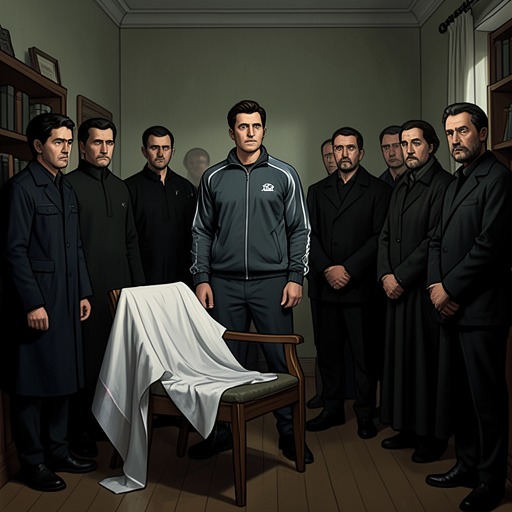
Queen Elizabeth II’s death suspends English football
Player Manager: A Sports Progression FantasyQueen Elizabeth II’s death suspends English football by converting a national moment of mourning into an abrupt interruption of the football calendar. The announcement reaches Max Best while he is trying to discuss a player’s prospects, and the emptying pitch, postponed fixtures, and enforced pause make the game’s absence feel less like a ceremonial gesture than a rupture in his daily life. The episode also becomes a test of who is trusted to gather in public: other sports continue, while football is treated as uniquely liable to disorder, even though Max believes its supporters would have behaved impeccably.
The Announcement and Immediate Disruption
Football stops in the middle of Max’s attempted negotiation. He is pressing for an opportunity for his player—a trial, perhaps a few sessions with the first team or the reserves—when the grey man tells him that “Her Majesty the Queen” is dead. The conversation is instantly rendered irrelevant. The place is deserted, other people have left, and even the strange figures around the pitch are disappearing. Max’s practical ambition collides with a national event that makes football temporarily unspeakable.
The announcements then arrive in rapid succession. Flint Town United against Aberystwyth Town is postponed, followed by Spurs against Manchester City and every other match in England. The stoppage reaches beyond the professional game: Scottish league and non-league fixtures are also called off, and even children’s matches are cancelled, meaning that nine-year-olds are not permitted to play. The breadth of the suspension gives the event its decisive force. This is not merely the loss of one televised fixture but a shutdown of the entire football ecology, from major league stadiums to local youth pitches.
Football in Mourning
The narrative describes the result in starkly compressed terms: “Football was in mourning.” The phrase gives the sport a collective body and treats its fixtures as a form of public gathering, ritual, and social continuity. For Max, who has recently begun to experience football through systems, interfaces, tactical screens, and newly consequential relationships, the cancellation produces an empty space. The game is not simply entertainment that has been removed from a schedule; it is the organizing structure of his week and a source of direction within a life otherwise threatened by boredom and uncertainty.
The interruption is extended by the expectation that the following weekend’s matches will also be postponed for the Queen’s funeral. Max accepts that postponing the funeral weekend is understandable, but regards the earlier cancellation as the mistake. The distinction reveals the event’s personal chronology: one lost round of games is followed by another, and then by a further break for national-team friendlies. A break followed by a break turns mourning into accumulated deprivation, leaving him to waste Friday and spend Saturday moving aimlessly around his house while thinking about the growing void in his life.
Unequal Public Trust
The suspension becomes politically charged because other sports continue. Cricket and golf proceed, as do more eccentric activities such as dog frisbee and extreme ironing. Their organizers can gather spectators so that they may collectively honour the Queen, while football is denied the same public role. Max reads this contrast as an expression of class suspicion. Football is “the working man’s game,” and its supporters are imagined as brutish and boorish people who would make a mess if allowed to assemble.
Max rejects that judgment. He considers the supporters capable of behaving impeccably, but emphasizes that they are never given the chance to demonstrate it. The Football Association is placed in a no-win situation: allowing Premier League matches to continue would invite hostile press coverage, especially from the Daily Mail, which Max identifies as Britain’s bestselling newspaper and recalls as having been pro-Nazi in the 1930s. His anger is therefore directed not only at the cancellation itself but at the unequal standards applied to football. He can understand cancelling the Premier League or even the top four divisions under political pressure, yet cannot see why Beth should be prevented from playing on Friday night.
Personal Consequences for Max Best
The stoppage deprives Max of both public football and private connection. Beth messages that the Friday game is cancelled, and Max responds with disbelief before irritating her by correcting her punctuation. He expects that she might invite him over to burn off her surplus energy, but she does not reply. The missed fixture therefore becomes a missed opportunity for companionship as well as sport, deepening the isolation that follows the national interruption.
The timing makes the loss especially severe. Max has already been drawn into a football world that he once found opaque: he now sees interfaces in his vision, including the “Max Best News” screen and its experience points, achievements, transfers, contracts, and records. He has begun to treat football as a system that can be read and manipulated, much as tactical screens, match statistics, and searchable incident reports later allow him to examine games. The suspension removes the live material on which that developing expertise depends. His football education cannot proceed through watching, attending, or experimenting when every level of the sport has been placed on hold.
Narrative Significance
The event exposes a contradiction at the heart of the story. Football is presented as a mass institution powerful enough to structure national attention, yet sufficiently stigmatized that its ordinary gatherings are treated as a special risk. The cancellation reveals football’s public importance through its absence: once matches disappear, Max and the narrative both register how much social, emotional, and intellectual activity had been packed into them.
The interruption also sharpens the book’s recurring concern with the difference between looking at football and understanding it. Max once complained that tactics vanished into precise but meaningless freeze-frames; later, the interface becomes responsive to his needs, displaying match overviews, tactical screens, statistics, and searchable corners. Against that developing mastery, the Queen’s death imposes a situation no interface can solve. It is an external event that overrides fixtures, personal plans, youth games, and professional ambitions at once. Football can be quantified, filtered, and tactically reorganized, but it remains subject to ceremony, hierarchy, public feeling, and institutional power.
Finally, the suspension forms a pointed contrast with the later pan-disability match involving the Chester Knights. That game insists that football’s reality is established by the players’ commitment, effort, tackles, and emotions, while the mourning stoppage asks who is entitled to participate in football’s public rituals. Together, the episodes show football as both an arena of exclusion and a shared practice whose meaning exceeds formal status. Queen Elizabeth II’s death pauses the game, but the pause makes its social reach impossible to ignore.